
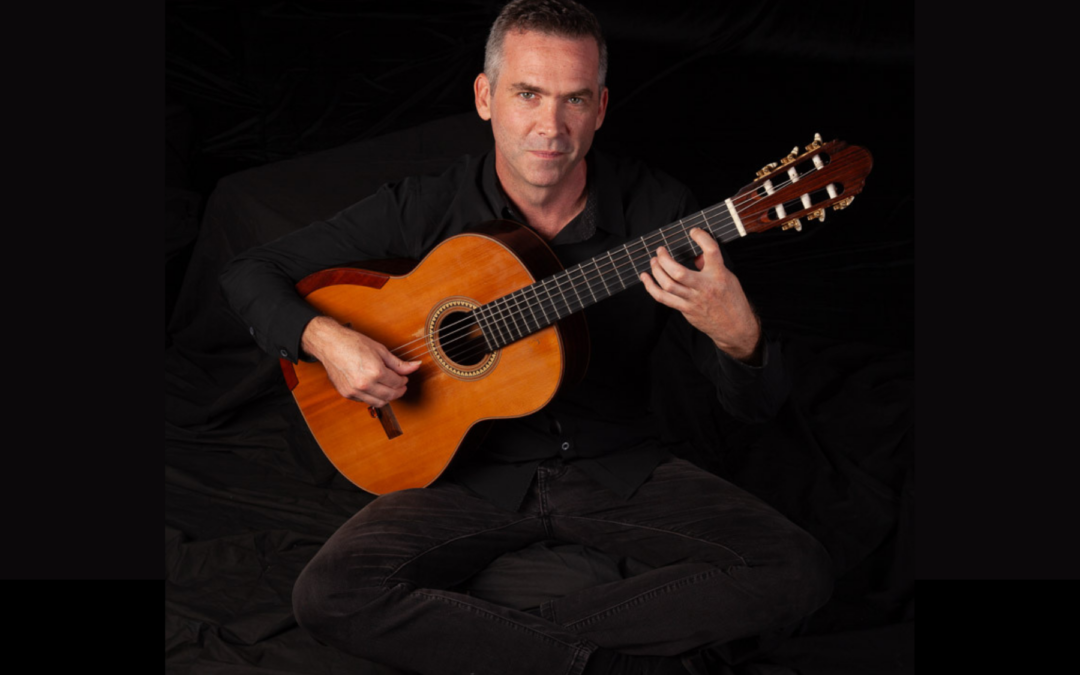
CANOVA DA MILANO Fantasias: 40; 21. Mon Père Si Ma Marie. EDUARDO SÁINZ DE LA MAZA Campanas del Alba. NÍN-CULMELL Six Variations on a Theme by Milan. REGINO SÁINZ DE LA MAZA Petenera. Zapateado. Rondeña. LAURO Valses venezolana: No. 3, Natalia; No. 2, Andreina. Suite Venezolana: El Registro (Preludio). Andreina. OHANA Tiento. BOGDANOVIĆ Mysterious Habitats
This recital takes the idea of a “tiento” as an “exploration, a musical act of seeking that can take many forms.” At its center is Maurice Ohana’s own Tiento; but the idea of a “seeking” is extended to the performer Brenda Evans’s musical life.
Here, the music spans the 16th century to the 20th (although Nín-Culmell died in 2004, his variations were written in 1955).
Two Fantasias by Francesco Canova da Milano (1497–1545) open the recording. Canova da Milano was known as “Il Divino” because of his virtuosity; most of his life he was aligned with the papal court. Some have commented on the influence of Josquin on his music. The recording was made with close attention to natural acoustic detail, and it shows. Evans’s sound is beautiful, the overall feeling of these two Fantasias intimate. Evans’s playing is stylish, too; this could almost be a lute. He is not alone to play it on a guitar: Julian Bream on his album The Woods So Wild includes No. 40, but Evans’s is the more convincing case. Paul O’Dette includes both on his (almost) all-Milano disc, the melancholy of No. 21 stunning; and Nigel North plays on a sweet-toned vihuela. Evans cedes to none. Finally for da Milano, Mon Père si ma Marie (“If my father marries me off” is a rough translation), based on an anonymous song. I like Evans’s teasing of repetitions very much.
Spanish guitarist and composer Eduardo Sáinz de la Maza (1903–82) is the younger brother of Regio, who features a little later in the recital. Campanas de Alba was written around 1960 and features harmonics which give something of a bell-like effect, plus a remarkable melody. It is lovely, and Evans’s account is characterized by its sensitivity. Later, we hear three pieces by Regio. First is the 1964 Petenera (the title refers to a melancholic song, named after a flamenco singer from Paterna de Riviera, near Cadiz). And while Narciso Yepes’s DG account is my go-to, Evans is just as compelling. Zapateado (1962) is a toe-tapping dance (“zapato” is shoe in Spanish), here with a melting contrasting section. Sharon Isbin is my go-to here, decidedly more rapid than Evans. But the two are complementary: Evans offers just so much color. The final piece is Rondeña (1962), for which I had no clear front-runner, so the field is clear for Evans. His lead-in to the contrasting theme is delicious.
Cuban-Spanish composer Joaquín Maria Nin-Culmell (1908–2004) studied with Dukas at the Paris Conservatoire, where he also encouraged Viñes and Cortot and de Falla. His father was Joaquín Nin (y Castellanos: but that one); his mother, Rosa Culmell, was a singer. Joaquín Maria joined the faculty of the University of California, Berkeley, in 1949. The label Column Musica released a disc of songs in 2003. Nin-Culmell’s set of variations is based on Renaissance vihuelist Luis Milán’s Pavana VI (D Minor) and was written for Cuban guitarist Rey de la Torre, who premiered it at New York Town Hall on November 10, 1947. Segovia left a particularly beautiful performance of the original. We certainly begin the variation journey at the original, and Evans is markedly more sensitive than Cuban guitarist Leo Brouwer, who recorded it in 1972 on LP (Les classiques de Cuba, Erato, issued in the USA as Musical Heritage Society MHS 3839), playing on a 1926 instrument from Barcelona by Francisco Simplicio. But Evans is way preferable and the recording mirrors his playing in its subtle placement. Evans takes his time, too, relishing the harmonies of the second variation before adopting a harder tone for the slow counterpoint at the octave of the Andante third. His elucidation of part-writing is superb, heard to finest advantage in that third variation.
Venezuelan composer Antonio Lauro (1917–86) was known for his work with folk tradition, particularly the “vals venezolano.” “Natalia” is Vals venezolano No. 3 and dates from around 1938–40. Dedicated to the daughter of a friend, the piece exudes warmth, while “El Registro” is the opening Preludio of Lauro’s Suite Venezolana of 1951/2. Cast in A Minor, its minor mode hangs quite heavily. Much as I like Craig Ogden’s playing of his piece, it is couched in a swimming recording. Finally for Lauro, the appealing “Andreina” (Vals venezolano No. 1; the missing valses are called “Tatiana” and “Marisela”).
The main work is by Maurice Ohana (1913–92), who still is not fully recognized for his importance. Here we have the 1957 Tiento. If Ohana’s music is known at all, it will probably either be via Julian Bream’s recording of Tiento, or Jean-Efflam Bavouzet’s spectacular disc of Ohana’s Douze Études (in two books: 1981/2 and 1984/5, on Harmonic Records), which is wholeheartedly recommended. These studies are honestly up there with Ligeti’s. Anyway, back to guitar. The reference points for this piece are a Folia theme, twisted as if in a mirror, Cabezón’s organ tientos, flamenco, microtones, and Lorca’s image of a guitar as a tarantula in his 1921 poem “La guitarra” (from Poema del Cante Jondo). The piece was commissioned by Narciso Yepes, and premiered in 1961. It is simply a magnificent work, and needs to be heard. Evans’s account is eminently persuasive, too, holding its head firmly up against Julian Bream.
Finally, Mysterious Habitats (1994) by Dušan Bogdanović (born 1955). The opening is marked “relaxed and flowing,” and perhaps Evans could be a touch more on the relaxed side (Bogdanović himself is slightly more so on his disc that takes its name from this piece; perhaps avoid Naxos’s Xavier Jara in the Laureate Series, who is rather earthbound). Despite the composer’s recording, it is Scott Tennant on Delos (Wild Mountain and Thyme) that gives this listener the most satisfaction: atmospheric and fully appreciative of the music’s harmonic twists. The score economically utilizes single-stave notation, and something of this comes across in performance. It emerges as a fine closing piece to Evans’s recital, perhaps in the manner of encore or even postscript to the Ohana. The final four-note chord (one of which is a harmonic) resounds on.
Overall, a brilliantly programmed disc, brilliantly played. My caveats are all minor; although in hard copy, I would have been grateful for more documentation (the album is also available to stream on Spotify). Colin Clarke
This article originally appeared in Issue 49:6 (July/Aug 2026) of Fanfare Magazine.