
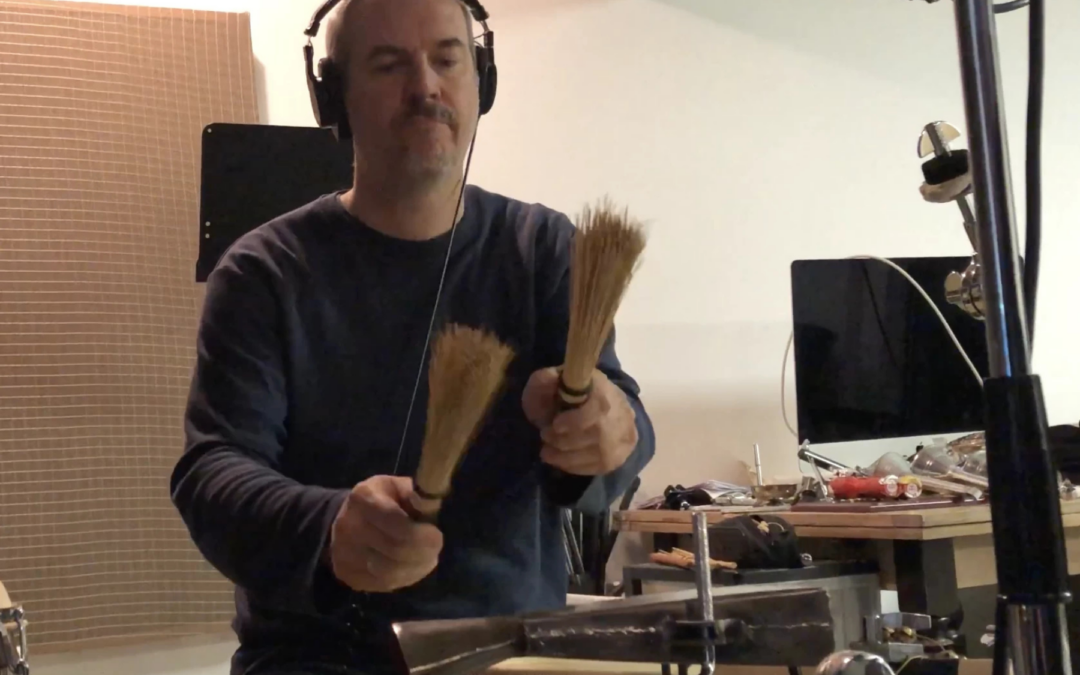
Not Just Rhythm, But Language
In John Finbury’s music, percussion is rarely about flash. It’s about voice, feel, and conversation. No one embodies this more clearly than Rogerio Boccato — the Brazilian percussionist whose work spans multiple Finbury albums, offering rhythmic depth without ever overpowering the ensemble.
From Sorte! to Quatro to Vã Revelação, Boccato’s playing is a constant: present, subtle, expressive. He brings a vocabulary rooted in Brazilian tradition but spoken with a jazz musician’s sensibility — always listening, always responding.
A Percussionist Who Paints
Rogerio Boccato doesn’t just play rhythms — he paints them. Whether on pandeiro, shaker, or frame drum, he creates textures that move with the melody rather than behind it. His playing adds shape to the music without dictating it.
On “Ring The Bells,” a tribute to Chick Corea co-written by John Finbury and Thalma de Freitas, Boccato’s percussion is like breath — gentle, spacious, and deeply felt. The absence of a drum kit draws the listener closer, and Boccato fills the space with a quiet intensity.
Sorte!: A Grounded First Encounter
The 2019 album Sorte! marked Boccato’s first recorded appearance in a Finbury project. Produced by Emilio D. Miler and featuring a powerhouse ensemble — including Airto Moreira, Duduka de Fonseca, John Patitucci, and Vitor Gonçalves — the album needed a percussionist who could balance complexity with restraint.
Boccato delivered. On tracks like “Filha” and “Oração,” his playing blends seamlessly with the ensemble, supporting the rhythm while also punctuating the harmonic shifts. His instruments don’t just mark time — they extend it, echo it, give it dimension.
Textural Interplay in Quatro
In Quatro (2020), Boccato’s role expands. The album, built on cross-cultural musical conversation, features both vocal and instrumental tracks with Magos Herrera, Chano Domínguez, Patitucci, and Antonio Sánchez.
Boccato’s percussion adds color without crowding. On “Comenzar,” his subtle accents interact with Domínguez’s piano phrasing, framing the lyric’s quiet strength. His choices are always intentional — a cymbal brush here, a hand drum pulse there — and always in service to the music.
Vã Revelação: Brazilian Forms, Modern Feel
In Vã Revelação (2024), Boccato joins a cast of Brazilian jazz masters supporting vocalist Bruna Black. The album explores Brazilian subgenres like baião, forró, and partido alto — forms Boccato knows intimately.
Yet his playing on this album isn’t traditional in a rigid sense. It’s responsive. He brings the soul of these rhythms into a jazz-influenced context, matching Bruna’s expressive delivery with percussive choices that enhance rather than anchor.
In “Chão De Nuvem,” Boccato’s percussion feels almost like a second voice — rising and falling with the phrasing, offering breath where words pause.
Collaboration Built on Trust
Finbury’s compositions are often intricate but not rigid. They allow — and require — musicians who can interpret, adapt, and listen. Boccato thrives in this kind of environment.
His collaborative relationship with producer Emilio D. Miler and musicians like Patitucci, Gonçalves, and Chico Pinheiro further strengthens the interplay on these recordings. There is an audible trust: Boccato knows when to lead, when to follow, and when to disappear.
Beyond the Tracklist: A Philosophy of Playing
Rogerio Boccato’s playing reflects a broader philosophy: percussion is not a backdrop — it’s part of the dialogue. His approach is less about asserting presence and more about enhancing presence — of melody, of emotion, of space.
This fits seamlessly with John Finbury’s compositional language, where melodic phrasing and harmonic shifts often carry emotional weight. Boccato responds to those moments not with volume, but with shape.
Less as More
It’s tempting in modern jazz to equate complexity with mastery. But Boccato shows another path: that silence, simplicity, and intentionality can carry as much power as virtuosity.
In John Finbury’s music — especially the quiet, spacious tracks — this kind of playing becomes essential. It allows the compositions to breathe, the vocalists to stretch, and the ensemble to find its own pulse.
Listen
Rogerio Boccato’s percussion appears on John Finbury albums including Sorte!, Quatro, and Vã Revelação. To explore his playing and other featured artists, visit Green Flash Music or stream the albums on major platforms.